
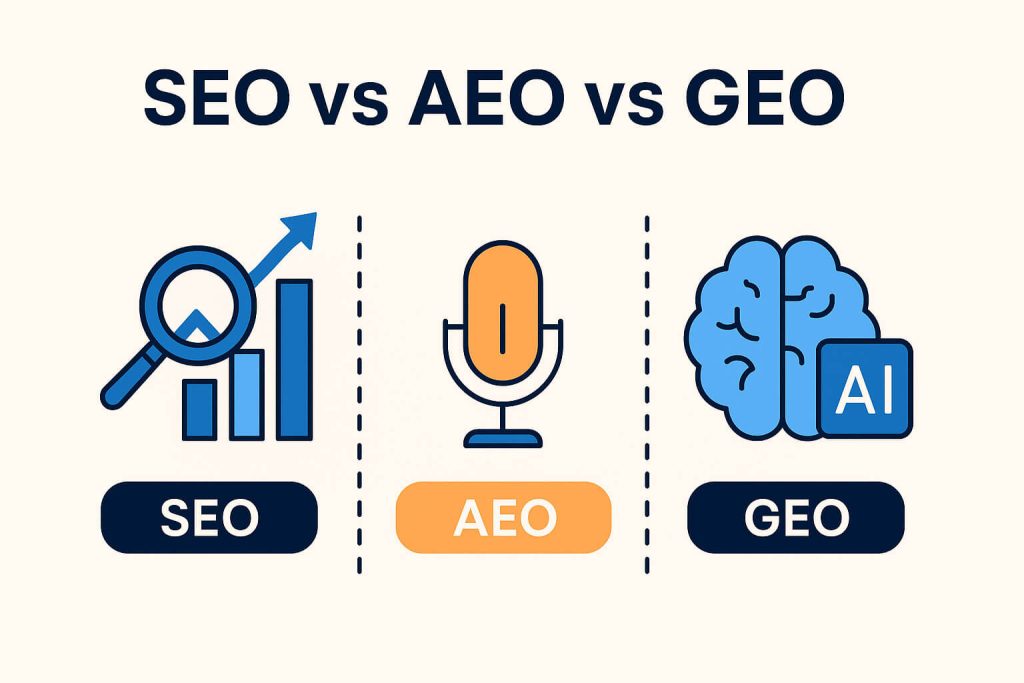
Search in 2025 isn’t just “SEO” anymore. It’s now a three-headed ecosystem: traditional Search Engine Optimisation (SEO), Answer Engine Optimisation (AEO) for conversational/answer-first systems, and Generative Engine Optimisation (GEO) for the LLMs and AI summaries that decide which sources to quote. To win visibility today, you need a blended strategy that targets all three. This guide explains what each is, how they differ, and critically, what to do to optimise for all of them in 2025.
Introduction — Why 2025 is the Year Search Became Multidimensional
Search is evolving from “ten blue links” into a multi-layered experience where AI-generated answers, chat-style overviews, and model citations increasingly determine what users see and trust. Google’s rollout of AI Overviews and broader generative experiences (often called SGE — Search Generative Experience) has accelerated this shift: search engines now deliver summarised, conversational answers at the top of results, often drawing from multiple web sources rather than pointing users to single pages.
The result: visibility isn’t just about ranking at #1 anymore — it’s about being referenced by AI systems (quoted, cited, or used as a source in an AI answer). That’s the fundamental idea behind AEO and GEO. Meanwhile, Google’s public guidance has pushed creators toward “people-first” content and stronger signals of experience, expertise, authority and trustworthiness (E-E-A-T), which remains central to all three strategies.
This post unpacks each discipline—SEO, AEO, GEO—shows how they intersect, and gives step-by-step tactics, measurement ideas, and a 2025-proofed checklist you can use right away.
What is SEO? (Search Engine Optimisation) — The Foundation
Definition: SEO is the practice of improving a website’s visibility in traditional search engines (Google, Bing, etc.) by optimising content, site structure, technical performance, and authority signals so pages rank for relevant queries.
Core components of SEO (2025 view)
- Keyword research & intent mapping: Find what real users ask (informational, navigational, transactional), map intent to pages, and create content that satisfies that intent.
- On-page optimisation: Titles, meta descriptions, header structure (H1/H2), semantic HTML, natural use of primary/secondary keywords and LSI terms.
- Technical SEO: Fast site speed, mobile-first design, correct indexability, canonicalization, structured data, and secure infrastructure (HTTPS).
- Content quality & topical authority: Long-form, well-structured content, internal linking, and deep topical clusters.
- Backlinks & authority building: Earning editorial links, partnerships, citations and references that boost perceived authority.
- SERP feature optimisation: Featured snippets, People Also Ask, image packs, video snippets, local packs, etc.
SEO in 2025 — what’s changed?
- E-E-A-T is even more central: Google’s guidance stresses people-first content and signals that demonstrate real-world experience as well as expertise and trust. That affects content formats, author bios, and how you cite sources.
- Multimodal relevance: Images, video, and audio are treated as native content signals in many SERPs; optimise alt text, transcripts, and metadata.
- Core web vitals and UX: Technical performance still matters — faster, more accessible pages earn more real user engagement signals that feed ranking systems.
Why SEO still matters: For most businesses, SEO remains the primary discovery channel that drives scalable organic traffic, brand awareness, and conversions. Even as AI answers grow, search engines still rely on the web to generate those answers, so being discoverable and authoritative in classic SERPs is a prerequisite to being referenced by AEO/GEO systems.
What is AEO? (Answer Engine Optimisation) — Be the Answer
Definition: Answer Engine Optimisation (AEO) focuses on making your content the direct answer that conversational AI and answer engines deliver to user queries — whether that’s a spoken voice response, a chat reply (ChatGPT, Copilot), or an AI-generated summary snippet.
AEO is about conciseness, clarity, and machine-readability so a platform can extract and serve your content as a complete answer rather than as a link.
How AEO differs from SEO
- Primary goal: SEO targets placement in result lists; AEO targets becoming the answer returned directly inside a conversational response or assistant.
- Format emphasis: AEO favours Q&A, FAQs, short, clear definitions, step-by-step instructions, and canonical short answers (snippets the model can copy).
- Contextual clarity: Machine-friendly structure (bullet lists, numbered steps, clear definitions) helps extraction by LLMs and answer engines.
Core AEO tactics (practical)
- Create snippet-ready answers: For every core query, include a short, direct answer (40–70 words) that succinctly answers the question, followed by a longer explanation.
- FAQ and Q&A schema: Implement structured data (FAQ, QAPage) where appropriate so engines can confidently identify question/answer pairs. (Note: schema doesn’t guarantee AEO placement, but it helps clarity.)
- Concise headers and modular sections: Use clear H2/H3 headings that mirror natural questions users ask; these are easier for models to map to prompts.
- Citation and sourcing: Provide clear citations and timestamps for claims so answer engines can verify and show provenance.
- Voice assistant optimisation: Include short variant answers suitable for spoken responses and test with voice search phrases.
- Monitor “answer share”: Track the percentage of queries where your content is surfaced as an answer (you’ll need to use specialised tools and mentions monitoring).
Resources & guides: Detailed AEO frameworks and playbooks have been published by industry leaders and consultancy blogs in 2024–2025 as conversational interfaces mature. The idea of optimising explicitly for answers (vs. ranked pages) is widely discussed in recent SEO literature.
What is GEO? (Generative Engine Optimisation) — Get Cited by Models
Definition: Generative Engine Optimisation (GEO) is the practice of optimising your content and online presence so that generative AI systems (large language models and search-AI overlays like Google AI Overviews, ChatGPT, Gemini, Perplexity, Bing Copilot, etc.) choose your content as a trustworthy source to cite, summarise, or reference in their answers.
Think of GEO not just as “appearing” but as being a preferred reference — the content that LLMs reach for when they construct an answer or generate a snippet.
How GEO differs from SEO and AEO
- Objective: SEO = rank; AEO = be the answer; GEO = be referenced in generative answers.
- Signal focus: GEO emphasises entity signals, authoritative sourcing, structured knowledge, provenance, and clarity around data and claims.
- Output orientation: GEO optimisation aims to increase the reference rate — how often models cite or paraphrase your content when generating an answer.
Core GEO strategies (practical)
- Entity optimisation & knowledge graph presence
- Ensure your brand, products, people (authors), and core concepts are clearly identified and consistently presented across the web (schema.org markup, About pages, knowledge panels).
- Citable assets
- Publish primary research, unique datasets, whitepapers, and clearly documented methodology — LLMs prefer primary, high-quality sources when available.
- Structured provenance
- Use clear author bylines, publish dates, data citations, and link to sources; structured citations increase trustworthiness for models.
- Long-form, semantically rich content
- LLMs favour deep, well-connected topical coverage when pulling context; create pillar pages and topical clusters with entity linking and clear internal references.
- API & data exposure for crawlable content
- Make sure valuable datasets are available in machine-readable formats (CSV, JSON-LD) where appropriate; this helps crawlers and model training pipelines.
- Brand training data hygiene
- Actively manage content that could be used for model training (public docs, high-value blog posts, PR releases). Where possible, publish canonical content that reduces ambiguity.
Industry coverage of GEO highlights that search visibility is shifting from pure positions to reference rates — how often a model chooses your content as a supporting source in a generated answer. This reframes content value from clicks to citations.
SEO vs AEO vs GEO — Side-by-Side Comparison
| Dimension | SEO | AEO | GEO |
|---|---|---|---|
| Primary goal | Rank in search results (SERPs) | Be the direct answer (chat/voice/assistant) | Be referenced/cited by generative models |
| Query type | Keyword-based; short/long tail | Conversational questions | Natural language & complex prompts |
| Content format | Pages, blogs, product pages | FAQs, snippets, Q&A, concise answers | Long-form, whitepapers, datasets, entity-first pages |
| Key signals | Backlinks, on-page, and UX metrics | Clarity, snippet-readiness, structured Q&A | Entities, provenance, unique data, knowledge graph presence |
| Measurement | Rankings, impressions, clicks | Answer placements, snippet shares | Reference rate, generative mentions, citation volume |
(Use this table to audit each page: what is it optimised for today, and what could you add to increase its AEO/GEO potential?)
How SEO, AEO, and GEO Work Together — An Integrated Playbook
Treat SEO, AEO, and GEO as layers of a single visibility stack — not competing channels.
Why integration matters
- A high-ranking page (SEO) that’s well-structured (AEO) and authoritative (GEO) has the highest chance of both appearing in SERPs and being used by generative systems.
- If you only optimise for clicks (SEO), you might still lose out on voice/assistant answers (AEO) and model citations (GEO).
- Conversely, content designed only for short answers (AEO) may lack the depth models prefer for referencing.
Practical integrated workflow (one-page blueprint)
- Keyword & intent research (SEO + AEO lens):
- Identify core head terms and the question variations users ask (use People Also Ask, “also asked” tools, and LLM prompts to find conversational variants).
- Choose a primary objective per page:
- Decide whether the page’s main role is to rank (SEO), answer (AEO), or serve as an authoritative reference (GEO). Many pages can and should serve multiple roles, but prioritise.
- Structure content modularly:
- Start with a concise answer (AEO snippet), then expand into a long-form section (GEO depth), and ensure on-page SEO basics (headers, meta).
- Add machine-readable signals:
- FAQ schema, Article schema, Person schema, and Dataset/CreativeWork schema where relevant.
- Publish citable assets:
- Add data tables, PDF whitepapers, and a clear methodology that models can cite reliably.
- Monitor & iterate:
- Track SERP rankings, snippet/answer placements, and generative mentions/citations (brand & content monitoring).
Example of a single content piece doing triple duty
- Page: “How to Reduce CAC by 25% in 6 Months (B2B Playbook)”
- AEO layer: At the top, a short 60-word answer: “To cut Customer Acquisition Cost by 25% in six months: 1) audit acquisition channels; 2) optimise top-performing channels; 3) improve onboarding conversion; 4) test pricing. Here’s how to implement each step.” (snippets)
- SEO layer: Keyword-rich title, meta description, subsections for each step, internal links to related case studies.
- GEO layer: Include dataset (before/after metrics in CSV/PDF), methodology, author credentials and company case study — material that an LLM can cite when summarising best practices.
Real-World Examples — How Brands Win (and Where They Fail)
Below are stylised examples that reflect trends seen across industries in 2024–2025.
Example 1 — Traditional SEO win
Situation: An e-commerce product page ranks #1 for a product keyword due to strong backlinks and well-optimised product schema.
Result: High organic clicks and conversions — but low inclusion in AI answers because the content is product-market copy with no clear, concise answer blocks or primary data.
Lesson: Rank is only half the battle — add clear answer snippets and citable product specs to improve AEO/GEO presence.
Example 2 — AEO win
Situation: A SaaS knowledge base includes succinct Q&A answers embedded in the FAQ schema. A conversational assistant surfaces the company’s answer directly for support questions.
Result: Reduced support tickets and high brand presence in assistant responses (reduced friction for customers), even if the page doesn’t rank #1.
Lesson: Add clear, short answers and a structured schema to earn direct assistant responses.
Example 3 — GEO win
Situation: A publisher releases an industry benchmark report with open data and a clear methodology. That report is repeatedly cited by AI overviews when summarising industry trends.
Result: Increased brand authority and “reference signals” in generative outputs — users see the brand’s data in AI summaries, improving trust and downstream traffic.
Lesson: Publish original data and make it machine-readable — models love primary sources.
Tools & Metrics: How to Measure Success for SEO, AEO, and GEO
Tools you’ll use (by discipline)
- SEO: Google Search Console, Google Analytics / GA4, Ahrefs, Semrush, Moz, Screaming Frog
- AEO: Monitor answer/featured-snippet share with Ahrefs/Semrush; use conversational AI (ChatGPT, Perplexity, Bing Chat) to run search prompts and log when your content appears; track voice search via GA events.
- GEO: Use brand-mention tracking (Mention, Brandwatch), Perplexity/ChatGPT searches to check citations, and specialised tools that index generative replies (emerging vendors). Also monitor referrals from “zero-click” surfaces where provided.
- Cross-discipline: Content analytics platforms (ContentKing, Frase, Surfer), schema validators, dataset hosting (figshare, GitHub).
KPIs (2025-relevant)
- SEO KPIs: organic impressions, clicks, average position, CTR, conversions.
- AEO KPIs: number of answer placements (featured snippet/assistant answer), voice-answer occurrences, decrease in support volume (for knowledge content).
- GEO KPIs: reference rate (times content is cited in AI outputs), generative mentions, model-driven traffic (clicks from AI answer pages or follow-up links), and branded query lift.
Note on measuring GEO: Because models generate answers by synthesising multiple sources, measuring citations is different from measuring backlinks. Use a mix of automated brand mention detection, manual LLM prompt checks (run your key queries in ChatGPT/Perplexity/Gemini), and monitor referral analytics from platforms that show click-throughs from AI-driven features. Industry thought pieces suggest the “reference rate” will be a standard KPI as early as 2025.
Step-by-Step Action Plan & Tactical Checklist (Start Today)
This checklist helps you update existing content and create new assets that score across SEO, AEO, and GEO.
Quick audit (30–60 minutes per top page)
- Search intent check: Does the page match the dominant intent? (Yes → keep; No → change H1/meta and content).
- Snippet check: Add a concise answer block (40–70 words) near the top of pages that satisfy common questions.
- Schema check: Implement Article, FAQ, QAPage, Person, Product, and Dataset schema where needed.
- Authorship & provenance: Add author bios, credentials, publish date, and methodology sections.
- Data & citation check: Add primary data, tables, and links to source documents (CSV/PDF).
- Internal linking: Add links to pillar pages and cluster pages to strengthen topical authority.
Content creation workflow (for new content)
- Research: Use keyword + question mining (People Also Ask, LLM prompts) to capture both keyword and conversational forms.
- Plan: For each target query, define whether the page’s main role is SEO, AEO, or GEO (or hybrid).
- Write: Begin with a short answer (AEO), then expand into a long-form explanation with data and entity connections (GEO), then finish with SEO-optimised meta/title and schema markup.
- Publish & expose data: Host downloadable datasets and clear citations.
- Test: Run targeted prompts in ChatGPT/Perplexity/Gemini to see whether your content is surfaced; adjust structure and clarity if not.
- Measure & iterate: Track SERP metrics, answer placements, and generative mentions.
Common Mistakes & Myths (and what to do instead)
- Myth: “AI answers will kill SEO.”
Reality: AI answers change the user journey (more zero-click queries), but organic search still drives discovery and remains a content foundation. Focus on being both findable and citable. - Myth: “Adding FAQ schema guarantees the AI will use my answer.”
Reality: Schema helps clarity, but models use many signals. Schema is necessary—not sufficient. - Myth: “Short answers are all you need for AEO.”
Reality: Short answers help AEO, but AEO success also depends on credibility and source quality. Combine concise answers with robust, citable supporting content. - Myth: “GEO is only for large publishers.”
Reality: Any brand can publish citable assets: case studies, data, whitepapers, reproducible methods. Unique, original content scales GEO value.
Future Trends: What Marketers Should Watch (2025 → 2030)
- Reference Rates over Rank Positions: Expect industry adoption of “reference rate” metrics — how often models cite your content — as a primary visibility KPI. Investors and product teams will want to know where their brand is referenced in AI outputs.
- AI-only search experiences & monetisation: Major engines have tested AI-only search flows (replacing blue links with AI summaries) and premium tiers that include advanced generative answers; this will change the distribution of traffic and monetisation models for publishers. Stay aware of platform policy and subscription features.
- Tighter accuracy & safety rules: Platforms are refining the scope of AI summaries to reduce hallucinations and will increasingly require reliable sources and better provenance signals. That benefits publishers who emphasise data, citations, and transparent methodology.
- Multimodal GEO: LLMs will increasingly cite images, audio, and video as sources. Optimise media with transcriptions, descriptive metadata, and clear licensing to increase model adoption.
- Brand training & dataset control: Larger brands may negotiate with model providers or publish structured datasets to influence how models reference their content. Expect more emphasis on structured, machine-readable corpora.
Final Checklist: 15-Point Audit to Make Your Content AEO + GEO Ready
- Short, direct answer at the top of the page (40–70 words).
- Clear H2/H3 headings match user questions.
- FAQ/QAPage schema implemented where relevant.
- Article, Person, and Organisation schema with author credentials.
- Publish dates and revision history are visible.
- Primary data or downloadable assets (CSV/PDF) whenever possible.
- Internal linking to pillar pages and topical clusters.
- External citations to authoritative sources with proper anchors.
- Accessible transcripts for audio/video.
- Mobile-first design + fast load times.
- Consistent entity references (brand, product, person names) across web properties.
- Monitor LLMs with manual prompts and mention tracking.
- Track answer placements and reference rates as KPIs.
- A/B test concise answer variants for better capture by assistants.
- Maintain a content governance plan to keep data and claims up to date.
Conclusion — The New Visibility Stack: Rank, Answer, and Be Referenced
In 2025, winning search visibility means doing three things well: rank (SEO), answer (AEO), and be referenced (GEO). Each discipline has distinct tactics, but they work best together. Start by shoring up SEO foundations, add AEO-friendly answer blocks and schema, and then publish citable, data-rich content that LLMs will want to use as a source.
If you take away one idea: stop optimising only for clicks. Start optimising for answers and references. That shift — from “rank positions” to “reference authority” — is the single biggest mindset change digital marketers need to make in 2025.
FAQs
Should I focus on SEO, AEO, or GEO first?
Start with SEO fundamentals (you can’t be referenced if you’re not discoverable), then add AEO elements (concise answers, FAQ schema) for high-value queries, and finally invest in GEO assets (data, research) where brand authority matters.
Will AI answers reduce my organic traffic?
Some queries may convert to zero-click answers, reducing clicks for those queries. But being referenced by AI often increases brand exposure and can drive other kinds of traffic and conversions. Also, good GEO/AEO work funnels users to deeper assets.
How do I measure if an LLM cites my content?
Use a combination of manual testing (prompting ChatGPT/Gemini/Perplexity for queries), brand monitoring tools, and analytics for referral patterns from platforms that surface citations. Emerging vendors also track generative mentions.
Does schema markup guarantee AEO or GEO appearance?
No. Schema increases machine readability and clarity, but doesn’t guarantee placement or citation. Quality, authoritativeness, and unique data matter far more.
Are smaller businesses at a disadvantage with GEO?
Not necessarily. Small businesses can win GEO by publishing original local data, case studies, and operational playbooks that models find useful and citable.