
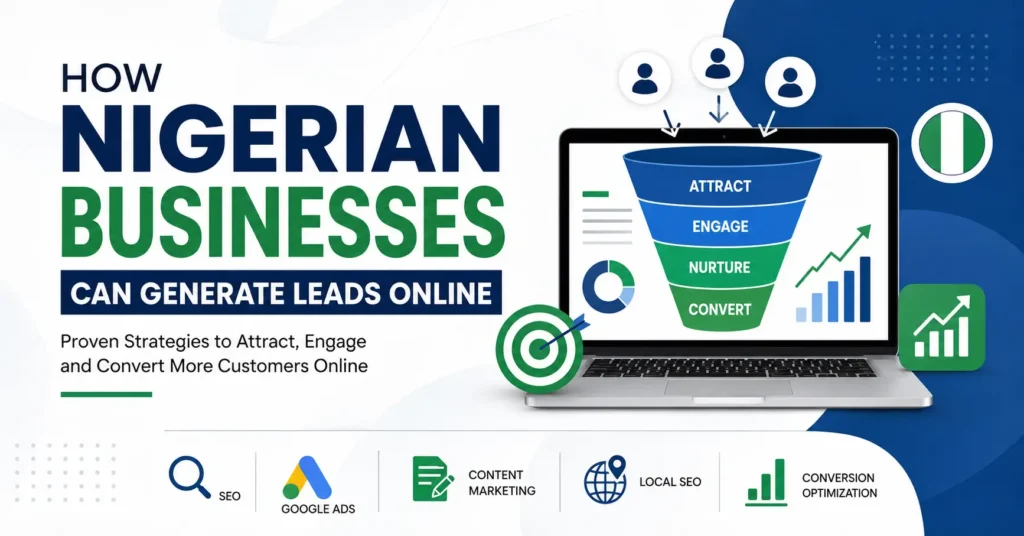
Nigerian businesses can consistently generate high-quality leads online by combining Search Engine Optimization (SEO), Google Ads, content marketing, local SEO, and a conversion-optimized website. Instead of relying solely on referrals or social media, businesses that build a strong digital presence across multiple channels attract more qualified prospects, reduce customer acquisition costs over time, and achieve sustainable business growth.
Introduction
The way Nigerians buy products and services has changed dramatically over the past decade. Whether someone needs a real estate agent in Lagos, a catering company in Abuja, a software developer in Port Harcourt, or a fashion designer in Enugu, the first place they usually turn to is Google. They search for information, compare providers, read reviews, and visit websites before making a purchasing decision.
This shift presents enormous opportunities for businesses that know how to position themselves online. According to DataReportal, Nigeria has tens of millions of internet users, with internet penetration and smartphone adoption continuing to grow each year. More consumers now research products and services online before contacting a business or making a purchase. That means your potential customers are already searching online—you simply need to ensure they find your business instead of your competitors.
Unfortunately, many Nigerian businesses still depend heavily on word-of-mouth referrals, offline marketing, or inconsistent social media activity. While referrals remain valuable, they are unpredictable and difficult to scale. Businesses that want consistent growth need a reliable system for attracting qualified leads every month.
Online lead generation provides exactly that.
By leveraging digital marketing strategies such as SEO, Google Ads, content marketing, local SEO, email marketing, and website optimization, businesses can consistently attract prospects who are actively searching for their products or services.
In this comprehensive guide, you’ll learn:
- What online lead generation means
- Why many Nigerian businesses struggle to generate leads
- Proven strategies to generate qualified prospects online
- Common mistakes to avoid
- Practical tips you can start implementing today
Whether you run a startup, SME, e-commerce store, professional service, healthcare practice, educational institution, or B2B company, the strategies in this guide can help you build a predictable pipeline of leads and customers.
What Is Online Lead Generation?
Online lead generation is the process of attracting potential customers through digital channels and encouraging them to express interest in your products or services.
A lead is simply someone who has shown interest in your business by taking an action such as:
- Filling out a contact form
- Requesting a quotation
- Booking a consultation
- Calling your business
- Sending a WhatsApp message
- Signing up for your newsletter
- Downloading a free guide
- Scheduling a product demo
Not every website visitor becomes a lead, and not every lead becomes a paying customer. Effective lead generation focuses on attracting qualified prospects—people who are genuinely interested in what you offer and are more likely to convert into customers.
Website Traffic vs. Leads
Many business owners celebrate high website traffic without realizing that traffic alone doesn’t pay the bills.
Consider these two scenarios:
Business A
- 50,000 monthly website visitors
- 25 enquiries
- 5 customers
Business B
- 3,000 monthly website visitors
- 200 enquiries
- 40 customers
Which business is performing better?
Business B.
Why? Because its website converts visitors into leads much more effectively. This highlights an important principle in digital marketing: quality traffic beats quantity every time.
Generating leads isn’t about attracting everyone. It’s about attracting the right people—those who have a genuine need for your product or service and are ready to take the next step.
What Makes a Qualified Lead?
A qualified lead typically has the following characteristics:
- They are actively searching for a solution.
- They fit your ideal customer profile.
- They have the budget to purchase.
- They have the authority to make or influence buying decisions.
- They show genuine intent through their actions.
For example, someone searching for “best SEO agency in Nigeria” is likely much closer to making a purchasing decision than someone searching for “what is SEO.”
Understanding search intent is crucial when creating content and marketing campaigns. Businesses that align their content with user intent generate significantly better conversion rates.
Why Most Nigerian Businesses Struggle to Generate Leads Online
Many businesses invest in websites, social media accounts, or occasional advertisements but still fail to generate consistent enquiries. The problem is rarely the internet itself—it is usually the absence of a well-defined digital marketing strategy.
Let’s examine the most common reasons.
1. They Don’t Have an SEO Strategy
Search Engine Optimization (SEO) remains one of the most cost-effective ways to generate long-term business leads. Yet many Nigerian businesses either ignore SEO entirely or misunderstand how it works.
Some common mistakes include:
- Publishing content without keyword research
- Targeting keywords nobody searches for
- Ignoring local SEO opportunities
- Failing to optimize title tags and meta descriptions
- Neglecting technical SEO
- Creating duplicate or thin content
Without SEO, your website becomes difficult to discover through organic search. Even if your services are excellent, potential customers may never find you because competitors occupy the top positions on Google.
Businesses that consistently invest in SEO often benefit from:
- Increased organic traffic
- Lower customer acquisition costs
- Higher trust and credibility
- Sustainable lead generation
- Long-term return on investment
2. Poor Website Design and User Experience
Your website functions as your digital storefront.
Imagine visiting a physical office with broken furniture, poor lighting, and confusing directions. Chances are you’d leave quickly.
The same principle applies online.
Common website issues include:
- Slow loading speeds
- Poor mobile responsiveness
- Outdated design
- Confusing navigation
- Broken links
- Difficult contact forms
- Poor readability
- Weak calls-to-action
Research consistently shows that users form an impression of a website within seconds. If visitors cannot quickly understand what you offer or how to contact you, they are likely to leave and choose a competitor.
An effective website should guide visitors naturally toward taking action, whether that means calling your business, requesting a quote, or booking a consultation.
3. No Clear Call-to-Action (CTA)
Many Nigerian business websites provide plenty of information but fail to tell visitors what to do next.
Every page should have a clear objective.
For example:
- Book a free consultation
- Request a quotation
- Call now
- Get started today
- Download our pricing guide
- Speak with an expert
- Send us a WhatsApp message
Without a clear CTA, visitors often leave without taking any action, even if they are interested in your services.
Strong CTAs remove uncertainty and increase conversion rates.
4. Slow Website Speed
Website speed has become an important ranking factor for search engines and a critical element of user experience.
If your website takes several seconds to load, visitors may abandon it before viewing your content.
Common causes include:
- Unoptimized images
- Poor hosting
- Excessive plugins
- Heavy JavaScript
- Lack of caching
- Large page sizes
A faster website generally leads to:
- Better search rankings
- Lower bounce rates
- Improved user satisfaction
- More enquiries
- Higher sales
Optimizing for Google’s Core Web Vitals can significantly improve both SEO performance and user experience.
5. Ignoring Local SEO
Many Nigerian businesses serve customers within a specific city or region.
For example:
- A dentist in Ikeja
- A law firm in Abuja
- A restaurant in Lekki
- An accounting firm in Port Harcourt
- A real estate company in Ibadan
These businesses should prioritize local SEO.
Optimizing your Google Business Profile, collecting customer reviews, maintaining consistent business information, and targeting location-specific keywords help increase visibility in Google’s local search results and Google Maps.
Local SEO is particularly valuable because it attracts people who are already looking for nearby businesses and are often ready to make a purchase.
6. Inconsistent Content Marketing
Publishing one blog article every six months is unlikely to generate meaningful results.
Successful businesses create valuable content consistently.
Content formats include:
- Blog posts
- Industry guides
- Case studies
- Videos
- FAQs
- Checklists
- Infographics
Quality content answers customer questions, demonstrates expertise, and helps build trust before a prospect ever contacts your business.
Over time, a well-developed content library becomes a powerful asset that attracts organic traffic and generates leads around the clock.
7. No Lead Tracking or Analytics
One of the biggest mistakes businesses make is failing to measure their marketing performance.
Without tools such as Google Analytics and Google Search Console, you cannot answer questions like:
- Which pages generate the most leads?
- Which keywords drive conversions?
- Where are visitors dropping off?
- Which marketing channels produce the highest ROI?
- How many enquiries come from organic search?
Data-driven decisions consistently outperform guesswork.
Tracking allows businesses to optimize campaigns, improve conversion rates, and allocate marketing budgets more effectively.
10 Proven Ways Nigerian Businesses Can Generate Leads Online
Now that we’ve identified the common obstacles, let’s explore practical strategies that consistently generate qualified leads.
The most successful businesses do not rely on just one marketing channel. Instead, they build a diversified digital marketing system where multiple channels work together to attract, nurture, and convert prospects.
1. Invest in Search Engine Optimization (SEO)
Search Engine Optimization remains one of the highest-return marketing investments available to Nigerian businesses.
Unlike paid advertising, where traffic stops as soon as your budget runs out, SEO continues generating visitors long after your content has been published and optimized.
When someone searches for terms like:
- SEO agency in Lagos
- Website design company in Abuja
- Best accounting firm in Nigeria
- Real estate agency in Lekki
- Digital marketing agency in Nigeria
Google evaluates hundreds of ranking factors before deciding which websites deserve the top positions.
If your website ranks on the first page, you receive highly targeted traffic from users who are actively looking for your services.
Why SEO Generates High-Quality Leads
SEO attracts people with intent.
These aren’t random users scrolling through social media. They’re searching because they have a problem they want to solve.
For example:
Someone searching “best CRM software for small businesses in Nigeria” has a much stronger purchase intent than someone casually browsing Facebook.
This makes SEO one of the most effective lead generation channels for service-based businesses.
Key Components of SEO
A successful SEO strategy typically includes:
- Keyword research
- On-page optimization
- Technical SEO
- Local SEO
- High-quality content creation
- Link building
- User experience optimization
- Performance monitoring
When combined, these elements improve your website’s visibility in search results and increase the likelihood of attracting qualified prospects.
Focus on Local Search Intent
If your business serves specific locations, optimize for location-based keywords such as:
- Digital marketing agency Lagos
- Web design company Abuja
- Accountant in Port Harcourt
- Real estate lawyer Enugu
These keywords often have lower competition and higher conversion rates because users are looking for nearby service providers.
Businesses that consistently invest in SEO create a long-term competitive advantage that compounds over time.
2. Create High-Quality, Helpful Content
Content marketing is the foundation of modern digital marketing.
Every day, potential customers search Google for answers to their questions before making purchasing decisions.
If your business provides those answers through helpful, well-researched, and optimized content, you position yourself as a trusted authority in your industry.
For example, a financial consulting firm might publish articles on tax compliance for SMEs, while a real estate company could create guides explaining the home-buying process in Nigeria. An e-commerce business might write product comparison articles that help customers make informed decisions.
This type of content doesn’t just attract visitors—it attracts people who are actively researching solutions and are more likely to become paying customers.
Why Educational Content Converts Better
Consumers today are more informed than ever. They compare options, read reviews, and evaluate expertise before reaching out to a business.
Educational content builds trust by demonstrating your knowledge without immediately pushing for a sale.
Helpful content can include:
- Comprehensive blog posts
- Step-by-step guides
- Industry insights
- Frequently asked questions
- Case studies
- Customer success stories
- Comparison articles
- Video tutorials
The more consistently you publish valuable content, the more opportunities your website has to rank for relevant keywords and generate qualified leads through organic search.
Businesses that treat content as a long-term investment often see compounding returns, with older articles continuing to attract traffic and enquiries months or even years after publication.
3. Run Google Search Ads to Capture High-Intent Buyers
While SEO is one of the best long-term lead generation strategies, it takes time to achieve strong rankings. If your business needs leads immediately, Google Search Ads can put it in front of people actively searching for your products or services.
Unlike social media advertising, which interrupts users while they’re browsing, Google Search Ads target people with existing purchase intent. These users are already searching for a solution—you need to position your business as the best answer.
For example, someone searching for:
- “SEO agency in Lagos”
- “Website designer near me”
- “Accounting firm in Abuja”
- “Corporate lawyer in Nigeria”
- “Cybersecurity training in Lagos”
is much closer to making a buying decision than someone scrolling through Instagram or Facebook.
Why Google Search Ads Work
Google Ads allows you to:
- Appear at the top of search results immediately
- Target specific keywords with commercial intent
- Control your daily advertising budget
- Track every click, enquiry, and conversion
- Reach customers based on their location, device, and search behaviour
With proper keyword targeting and optimized landing pages, Google Ads can generate qualified leads within days rather than months.
Best Practices for Google Ads
To maximize your return on investment:
- Focus on high-intent keywords rather than broad terms.
- Use compelling ad copy that highlights your unique value proposition.
- Create dedicated landing pages instead of sending traffic to your homepage.
- Add relevant ad extensions such as phone numbers, location information, and sitelinks.
- Monitor your Quality Score to reduce your cost per click.
- Continuously test headlines, descriptions, and calls-to-action.
Many businesses lose money on Google Ads not because the platform doesn’t work, but because their campaigns lack proper keyword research, landing page optimization, and conversion tracking.
4. Optimize Your Website for Conversions
Generating website traffic is only half the battle. If visitors don’t take action after arriving on your website, your marketing efforts won’t deliver the desired results.
Conversion Rate Optimization (CRO) focuses on increasing the percentage of website visitors who become leads or customers.
What Is a Conversion?
A conversion occurs when a visitor completes a desired action, such as:
- Filling out a contact form
- Calling your business
- Clicking your WhatsApp button
- Booking a consultation
- Requesting a quotation
- Purchasing a product
- Signing up for a newsletter
Improving your conversion rate means generating more leads without increasing your marketing budget.
Elements of a High-Converting Website
Your website should include:
Clear Value Proposition
Within the first few seconds, visitors should understand:
- What you do
- Who you help
- Why they should choose you
Avoid vague marketing jargon. Clearly communicate your expertise and the benefits of your services.
Mobile Responsiveness
Most Nigerians access the internet through smartphones. If your website isn’t optimized for mobile devices, you’re likely losing a significant percentage of potential customers.
Your website should:
- Adapt to different screen sizes
- Load quickly
- Display readable text
- Have clickable buttons
- Offer easy navigation
Fast Loading Speed
Website speed directly affects:
- User experience
- Bounce rate
- Google rankings
- Conversion rates
Compress images, enable caching, use quality hosting, and minimize unnecessary scripts to improve loading times.
Strong Calls-to-Action
Every important page should encourage visitors to take the next step.
Examples include:
- Get a Free Consultation
- Request a Quote
- Schedule a Demo
- Speak With Our Team
- Start Your Project Today
Use action-oriented language and place CTAs strategically throughout your pages.
Social Proof
People trust businesses that others recommend.
Display:
- Customer testimonials
- Case studies
- Google reviews
- Industry certifications
- Awards
- Client logos
Social proof builds credibility and reduces hesitation during the buying process.
5. Optimize Your Google Business Profile for Local Visibility
If your business serves customers in a specific location, optimizing your Google Business Profile is one of the easiest ways to generate local leads.
When users search for terms such as:
- “Restaurant near me”
- “Digital marketing agency Lagos”
- “Dentist in Ikeja”
Google often displays a map listing before the traditional search results.
Appearing in these local results can significantly increase:
- Phone calls
- Website visits
- Direction requests
- Walk-in customers
How to Optimize Your Google Business Profile
Ensure your profile includes:
- Accurate business name
- Correct address
- Phone number
- Website URL
- Business categories
- Operating hours
- High-quality images
- Updated business description
Encourage satisfied customers to leave reviews. Businesses with more positive reviews often receive better visibility and higher click-through rates.
Respond professionally to every review—both positive and negative—to demonstrate your commitment to customer satisfaction.
6. Use Social Media to Support Your Lead Generation Strategy
Social media platforms such as LinkedIn, Facebook, Instagram, TikTok, and X (formerly Twitter) play an important role in brand awareness and customer engagement.
However, one common mistake businesses make is treating social media as their primary marketing channel.
Remember: you don’t own your followers. Algorithms change, reach fluctuates, and platforms evolve. Your website should remain the central hub of your digital marketing strategy.
Use Social Media Strategically
Rather than posting randomly, create content that supports your broader marketing objectives.
Examples include:
- Educational tips
- Behind-the-scenes content
- Customer success stories
- Industry insights
- Short videos
- Infographics
- Frequently asked questions
Direct users back to your website, where they can learn more, download resources, or contact your team.
For B2B businesses, LinkedIn is particularly effective for reaching decision-makers and professionals.
7. Offer a Valuable Lead Magnet
Not every visitor is ready to make a purchase immediately.
Some need additional information before making a decision.
A lead magnet provides something valuable in exchange for a visitor’s contact information.
Examples include:
- Free SEO audit
- Free consultation
- Pricing guide
- Industry report
- E-book
- Checklist
- Marketing template
- Webinar
A good lead magnet solves a specific problem and demonstrates your expertise.
Once prospects join your email list, you can continue nurturing them until they’re ready to buy.
8. Build and Nurture an Email List
Email marketing remains one of the highest-return digital marketing channels.
Unlike social media, your email list belongs to you.
You aren’t dependent on changing algorithms or declining organic reach.
Benefits of Email Marketing
Email allows businesses to:
- Educate prospects
- Share industry insights
- Promote new services
- Announce special offers
- Build long-term relationships
- Encourage repeat purchases
Instead of sending only promotional emails, focus on delivering value.
Useful content builds trust and keeps your business top of mind when prospects are ready to make a purchasing decision.
Marketing automation platforms can also help segment audiences based on behaviour, ensuring recipients receive relevant content.
9. Use Customer Testimonials and Case Studies
Trust is one of the biggest factors influencing buying decisions.
Potential customers want evidence that you’ve successfully helped businesses similar to theirs.
Customer testimonials and case studies provide that reassurance.
What Makes an Effective Case Study?
A strong case study should explain:
- The client’s initial challenge
- Your proposed solution
- The implementation process
- Measurable outcomes
- Client feedback
Whenever possible, include specific metrics.
For example:
- Organic traffic increased by 180%
- Leads grew by 95%
- Conversion rate improved from 2.1% to 5.8%
- Cost per acquisition reduced by 42%
Specific numbers make your claims more credible and persuasive.
10. Track, Measure, and Improve Your Marketing Performance
Successful businesses make decisions based on data rather than assumptions.
Without tracking performance, it’s impossible to know which marketing activities are producing results.
Essential Marketing Metrics
Monitor metrics such as:
- Organic traffic
- Conversion rate
- Bounce rate
- Average session duration
- Cost per lead
- Customer acquisition cost
- Return on ad spend (ROAS)
- Customer lifetime value (CLV)
Recommended Tools
Useful platforms include:
- Google Analytics 4
- Google Search Console
- Google Tag Manager
- Microsoft Clarity
- Google Ads Conversion Tracking
Review your data regularly and continuously improve your campaigns based on real user behaviour.
Digital marketing is not a one-time activity—it is an ongoing process of testing, learning, and optimization.
Which Online Marketing Channel Generates the Best Leads?
No single marketing channel is ideal for every business. The best approach depends on your goals, budget, competition, and target audience. However, combining multiple channels often delivers the strongest results.
| Marketing Channel | Cost | Speed | Long-Term ROI | Best For |
|---|---|---|---|---|
| SEO | Medium | Slow | Excellent | Sustainable organic growth |
| Google Ads | Medium to High | Fast | Good | Immediate lead generation |
| Content Marketing | Medium | Slow | Excellent | Building authority and trust |
| Email Marketing | Low | Medium | Excellent | Lead nurturing and retention |
| Local SEO | Low to Medium | Medium | Excellent | Location-based businesses |
| Social Media Marketing | Medium | Medium | Moderate | Brand awareness and engagement |
The most successful Nigerian businesses combine SEO, content marketing, Google Ads, email marketing, and conversion optimization into a unified lead generation strategy.
Common Mistakes Nigerian Businesses Should Avoid
Even businesses with significant marketing budgets can struggle if they make avoidable mistakes.
Common pitfalls include:
- Focusing on vanity metrics such as likes and followers instead of qualified leads
- Running paid ads without optimized landing pages
- Ignoring SEO in favour of short-term tactics
- Publishing low-quality or duplicate content
- Failing to optimize for mobile users
- Neglecting local SEO opportunities
- Using weak or unclear calls-to-action
- Ignoring website analytics and conversion tracking
- Targeting overly broad audiences
- Inconsistently publishing content
Avoiding these mistakes can significantly improve your marketing performance and reduce wasted advertising spend.
Final Thoughts
Generating leads online isn’t about chasing the latest marketing trend—it’s about building a reliable system that consistently attracts, nurtures, and converts potential customers.
Businesses that rely solely on referrals or occasional social media posts often experience inconsistent growth. In contrast, companies that invest in SEO, high-quality content, Google Ads, local SEO, conversion optimization, and performance tracking create a scalable lead generation engine that continues delivering results over time.
Remember, digital marketing is a marathon, not a sprint. The businesses that achieve sustainable success are those that consistently improve their online presence, analyze their data, and adapt to changing customer behaviour.
If you’re serious about growing your business online, start by implementing one strategy at a time, measure the results, and build from there. Over time, these incremental improvements can lead to significant increases in website traffic, qualified leads, and revenue.
Ready to Generate More Qualified Leads for Your Business?
At Crank Digital, we help Nigerian businesses move beyond guesswork with data-driven digital marketing strategies that deliver measurable results.
Whether you need to increase your visibility on Google, generate more qualified enquiries, improve your website’s conversion rate, or launch high-performing Google Ads campaigns, our team has the expertise to help you achieve your growth goals.
Our services include:
- Search Engine Optimization (SEO)
- Google Search Ads (PPC)
- Content Marketing
- Local SEO
- Conversion Rate Optimization (CRO)
- Website Design and Optimization
- Analytics and Performance Tracking
Every business is different, which is why we develop customized strategies tailored to your industry, audience, and objectives—not one-size-fits-all solutions.
Ready to grow your business online? Visit Crank Digital to schedule a consultation and discover how we can help you attract more qualified leads, convert more customers, and achieve sustainable business growth.
FAQs
How long does SEO take to generate leads?
SEO is a long-term strategy. Most businesses begin seeing measurable improvements within three to six months, although highly competitive industries may take longer. Consistency, quality content, and technical optimization are key to long-term success.
Is Google Ads better than SEO?
Neither is inherently better—they serve different purposes. Google Ads delivers immediate visibility and faster results, while SEO provides sustainable, long-term traffic and often lowers customer acquisition costs over time. Many businesses achieve the best results by using both together.
What is the most effective lead generation strategy for Nigerian SMEs?
A combination of SEO, local SEO, Google Ads, content marketing, email marketing, and a conversion-focused website typically delivers the best results. The right mix depends on your industry, budget, and target audience.
Can small businesses generate leads online with a limited budget?
Yes. Small businesses can start with affordable strategies such as local SEO, content marketing, Google Business Profile optimization, and email marketing before expanding into paid advertising.
Why is my website getting traffic but no enquiries?
This usually indicates a conversion problem rather than a traffic problem. Common causes include weak calls-to-action, poor user experience, slow loading speed, irrelevant traffic, or a lack of trust signals such as testimonials and case studies.